


Page 2 - Positional stability of field-reversed-configurations in the presence of resistive walls
P. 2
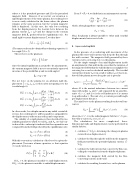
where π is the perturbed pressure and Q⃗ is the perturbed magnetic field. However, if we restrict our attention to rigid displacements of the entire plasma, the resulting force is more easily calculated in the frame where the plasma remains at the same position, but the vacuum magnetic field is displaced. In this case, the only force resulting from the displacement is the Lorentz force between the plasma current ⃗jp = jθ θˆ and the change in the vacuum magnetic field B⃗v produced by the equilibrium coils. For small rigid/constant displacements ⃗ξ, we thus have
⃗f(⃗ξ)=−⃗j × (⃗ξ·∇)B⃗ (2) pv
(The same result can be obtained by evaluating equation (1) for a rigid ⃗ξ(⃗x ) = ⃗ξ.)
2 From ∇ × B⃗v = 0, we find that in an axisymmetric system
r ∂2ψ − ∂ψ +r ∂2ψ =0 (11) ∂z2 ∂r ∂r2
which, when plugged into equation (5), gives
Fzc = −2Fxc (12)
Thus, the plasma is always unstable to either axial or radial displacements, but never to both.
The net force on the plasma is
In the presence of a conducting wall, movement of the plasma will excite wall currents that keep the flux through the wall constant. The magnetic field generated by these currents exerts a restoring force on the plasma.
For the simple example of an axial displacement inside an axisymmetric, thin wall (in the sense that the variation of the magnetic field within the wall thickness is negligible) the restoring force can be calculated analytically. The toroidal current line density Iw(z) in a wall of radius rw(z) that is in- duced if the plasma moves along the axis is given by
Iw(z)=− 1 ∂jθ(r′,z′) M(r′,rw(z),z−z′)dV′ L(rw(z)) plasma ∂z′
(13) where M is the mutual inductance between two current rings with radius rw and r′ and separated by an axial dis- tance of z − z′, and L(r ) is the self-inductance of a current loop with radius r . The unit of Iw is current per wall length
per displacement distance.
The axial force on the plasma resulting from the wall cur-
F⃗(⃗ξ) =
⃗f (⃗ξ) dV
Since the initial equilibrium is assumed to be axisymmetric, the vacuum magnetic field is most conventiently expressed in terms of the poloidal flux ψ and toroidal angle θ:
B⃗v=∇ψ×∇θ (4) The net force on the plasma for an arbitrary rigid dis-
placement ⃗ξ = {ξx , ξy , ξz } is then (after integrating over the toroidal angle θ):
(3)
B.
Superconducting Walls
⃗⃗ F(ξ)·xˆ=πξx
∂2ψ 1∂ψ
jθ(r,z) ∂r2 −r ∂r drdz (5)
∂2ψ 1∂ψ
F⃗(⃗ξ)·yˆ=πξy jθ(r,z)∂r2−r∂rdrdz (6)
⃗⃗ ∂2ψ
F(ξ)·zˆ=2πξz jθ(r,z) 2 drdz (7)
In other words, for a displacement in any radial or axial di- rection, the resulting force will be parallel or antiparallel to the displacement, without any orthogonal components.
The stability of a rigid plasma is thus described by two stability parameters which we call Fzc and Fxc (we have in- troduced the c subscript to indicate that these quantities are computed from the field produced by the equilibrium coils):
Fzc = zˆ · F⃗(zˆ) = ∥F⃗(zˆ)∥ (8) Fxc = xˆ · F⃗(xˆ) = ∥F⃗(xˆ)∥ (9)
With this convention, calculation of the force for a given dis- placement ⃗ξ becomes a linear operation, so that equation (3) can be written as
Fzw = dV′jθ plasma wall
Bw(r′,z′,z)dz (14)
Fxc 0 0 F⃗(⃗ξ)= 0 Fxc 0 .⃗ξ≡F.⃗ξ 0 0 Fzc
3. calculate the wall currents that conserve the flux, can- (10) celling the contribution from the displaced plasma
If Fzc > 0, the plasma is unstable to axial displacements. If Fxc > 0, the plasma is unstable to radial displacements.
4. calculate the magnetic field excited by the flux- conserving currents in the wall
5. calculate the resulting Lorentz force on the plasma
rents is:
∂z
where Bw(r ′, z′, z) is the radial magnetic field at (r ′, z′) pro- duced by a current Iw at (rw(z′), z′).
The calculations for more complicated, three- dimensional walls and displacements can be performed in similar fashion:
1. calculate (⃗ξ · ∇)⃗jp to determine the change in plasma current from a displacement ⃗ξ
2. calculate the flux through the wall from the magnetic field generated by the perturbed plasma current, (⃗ξ · ∇ ) ⃗j p .


