
TAE shortens device roadmap, prepares for commercial era
TAE’s Norm machine – the first to produce FRC plasmas with only neutral beam injection – has performed beyond expectations, leapfrogging a planned sixth device, Copernicus. The announcement below was published as part of the 2025 annual meeting of the APS Division of Plasma Physics.
Foothill Ranch, Calif. — November 17, 2025 — A breakthrough in Magnetic Fusion Energy has been achieved at TAE Technologies. Researchers have demonstrated the first-ever successful formation of a Field-Reversed Configuration (FRC) plasma using only neutral beam injection (NBI) – a goal pursued by fusion scientists for more than three decades.
A Simpler, Less Complex Path to an FRC
Delivering commercial fusion hinges on the ability to generate a plasma (the superheated fourth state of matter) at extraordinarily high temperatures and then confine the energy for extended periods of time. One of the most commercially attractive ways to do this is via the magnetic confinement of an FRC.
TAE’s approach to fusion employs the FRC’s inherent advantages: high power density, linear geometry, unrestricted divertors and compatibility with clean, aneutronic fuels such as abundant hydrogen-boron. The FRC plasma self-organizes and creates its own magnetic field inside the fusion reactor chamber, greatly reducing the external magnetic field strength required for confinement while making the device substantially more power efficient to operate.
FRC plasma formation, however, has historically been a complex process.
In TAE’s prior fusion research reactor, Norman, an FRC plasma was formed using lengthy theta-pinch formation sections to generate a supersonic collision in the central confinement vessel. TAE’s new method eliminates the traditional formation coils and associated plasma initiation hardware – producing a simpler, smaller and more efficient fusion machine that reduces reactor length and complexity by up to 50 percent, directly improving cost and scalability for future power plants.
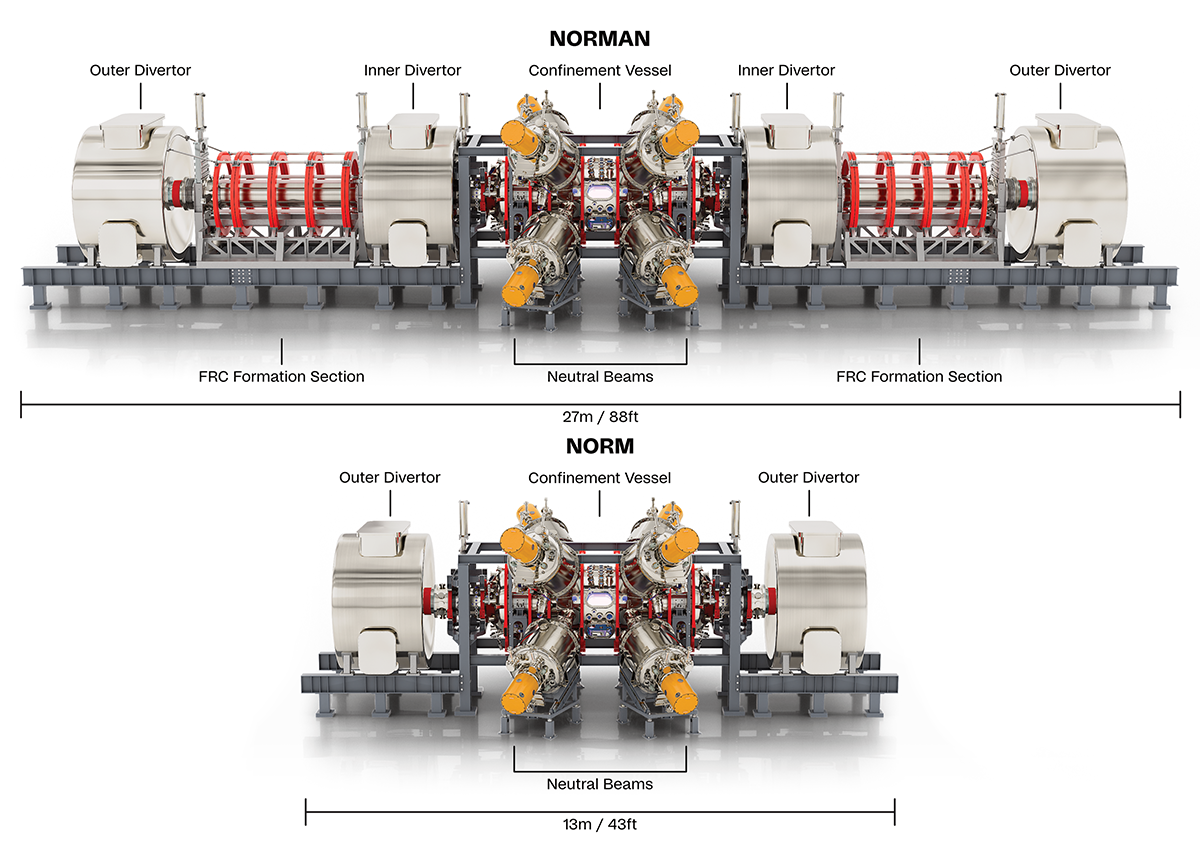
TAE has streamlined its fusion reactor design. Compared to the company’s prior device, Norman,
Norm increases efficiency, reduces complexity and cost, and accelerates TAE’s path to commercial fusion power.
As demonstrated in TAE’s streamlined fusion research reactor, Norm, energetic neutral beams are injected into a magnetically confined initial seed plasma, where the trapped beam ions create a strong toroidal current. Within approximately 10 milliseconds, this toroidal plasma current builds naturally into a fully formed FRC right in the center of the device.
These findings, published in Nature Communications and presented at the 2025 meeting of the American Physical Society Division of Plasma Physics (APS–DPP), show that NBI-driven FRC formation is not only possible, but stable and repeatable. This achievement offers a dramatically less complex and more economical fusion reactor design that has now propelled TAE’s proprietary fusion technology into its commercial era.
April 2025: TAE Technologies Delivers Fusion Breakthrough with NBI-Only FRC Plasma Formation
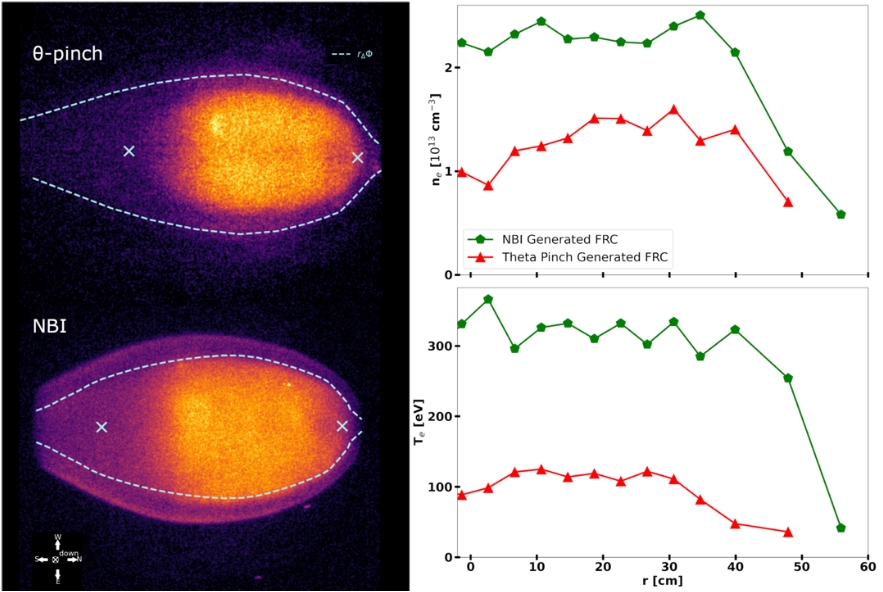
Comparison of Field-Reversed Configuration (FRC) equilibria generated by neutral beam injection (NBI) and theta-pinch. Left: Images from a fast-framing camera of O4+ emission at 650 nm with overlay of excluded flux radius (a proxy for plasma radius) and estimated X-points. The emission is strongest in the core where electron density (ne) and temperature (Te) are elevated. The camera’s perspective accounts for the apparent lack of symmetry of the X-points. Right: Figures compare ne and Te profiles for NBI and theta-pinch. Density and temperature have both increased significantly due to NBI heating and configuration optimization, specifically through magnetic field shaping, edge biasing, and fueling.
A Shorter, Less Expensive Timeline to Commercial Fusion
With its NBI-only approach to plasma formation, Norm has produced such record performance in plasma temperature, FRC stability and machine efficiency that TAE can shorten its roadmap. Where TAE previously planned for a sixth-generation machine, Copernicus, to follow Norm, the company is now able to move directly into the development of its first of a kind fusion power plant, Da Vinci.
“When we achieved the NBI-only formation in Norm, we knew it would be transformative for performance, practicality and reactor-readiness of our fusion technology,” says Michl Binderbauer, TAE’s Chief Executive Officer. “What we realized with continued experimentation is that Norm’s performance is putting us exactly where we want to be to begin development of our commercial power plant. Our sixth-generation machine, Copernicus, had been part of our roadmap since TAE’s beginning, but Norm is such a tremendous breakthrough that it renders Copernicus unnecessary – saving us considerable time and cost. We’re thrilled with the momentum Norm’s success has brought to TAE’s cleanest, safest approach to fusion.”
“The demonstration of NBI-only FRC formation resolves a central challenge for beam-driven fusion: how to generate and maintain self-organizing, closed-field plasmas without complicated start-up systems,” says Toshiki Tajima, TAE’s Chief Science Officer. “TAE’s critical innovations in neutral beams, power supplies and real-time active feedback control have paved the way for this breakthrough – not only reducing system complexity and cost but also improving plasma stability and overall reactor performance.”
Norm routinely delivers TAE’s highest plasma performance and is now being upgraded to achieve 100 million degrees Celsius – the highest temperature ever recorded on a steady-state FRC – to validate the operating modes and hardware for TAE’s next-generation reactors. Norm’s strong NBI-only performance further reinforces confidence that TAE has resolved the remaining complexities of FRCs and has materially de-risked its hydrogen-boron power-plant design to deliver commercial fusion by the early 2030s.