No Results Found
The page you requested could not be found. Try refining your search, or use the navigation above to locate the post.


The page you requested could not be found. Try refining your search, or use the navigation above to locate the post.

In some ways, scientists at the Department of Energy’s National Ignition Facility (NIF) have been a bit down and out. The $3.5 billion facility was designed to replicate the atom-smashing reactions that occur inside the sun, a difficult process that requires enormous amounts of heat and pressure, and could theoretically solve humanity’s energy and climate woes.
But technical obstacles put NIF a decade behind in its goal of achieving fusion “ignition,” that is, getting more energy out of one of those reactions than it put in. The facility uses the largest lasers in the world to try and do that, focusing energy on a tiny capsule filled with hydrogen isotopes.

U.S. scientists have achieved “ignition” — a fusion reaction that produced more energy than it took to create — a critical milestone for nuclear fusion and a step forward in the pursuit of a nearly limitless source of clean energy, Energy Department officials said Tuesday.
Nuclear fusion, the process that powers the sun and other stars, occurs when two atoms’ nuclei collide under extreme temperatures, causing a reaction that can generate incredible amounts of energy with few environmental costs.

The latest step toward pollution-free power has the potential to transform the energy sector, perhaps decades from now, but some companies are already positioning themselves to benefit.
Energy Secretary Jennifer Granholm said on Tuesday that scientists at the Lawrence Livermore National Laboratory in California had made “a tremendous scientific breakthrough” in their tests of nuclear fusion, the reaction that powers the sun. While prior efforts to achieve fusion—combining two hydrogen atoms to produce helium in a reaction that produces energy—consumed more energy than they released, the Livermore scientists flipped the balance.

The promise of zero-carbon energy has long been too good to be true, but researchers say they’ve found a breakthrough in what’s known as fusion energy. Fusion energy is a process that occurs in our Sun and other stars and doesn’t emit greenhouse gasses or radioactive waste.
The Department of Energy is expected to announce tomorrow that researchers at the Lawrence Livermore National Lab in California have used lasers to produce a nuclear fusion reaction that creates energy. NBC News’ Tom Costello shares more about what scientists are calling the “Holy Grail” of clean energy.

North Carolina has enacted landmark energy legislation that recognizes fusion technology’s safety and environmental benefits. Senate Bill 678 demonstrates the state’s commitment to investing in fusion as a new clean electricity source that can be an important part of the state’s energy mix.
Assembly Bill 1172 supports California’s fusion energy industry by recognizing this cutting-edge technology’s safety and environmental benefits while setting the stage for the state’s future regulatory framework.

TAE Life Sciences, a pioneer in advancing Boron Neutron Capture Therapy (BNCT) for cancer treatment, is thrilled to announce it is bringing BNCT to this year’s annual meeting of the American Society for Radiation Oncology (ASTRO) in San Diego.

TAE Life Sciences, a pre-clinical stage biotech company focused on advancing the field of radiation oncology through accelerator-based Boron Neutron Capture Therapy (BNCT), announces the appointment of Rob Hill as its new Chief Executive Officer (CEO). Hill succeeds Bruce Bauer, a co-founder of TAE Life Sciences, who served as the company’s CEO since it was founded in 2017.
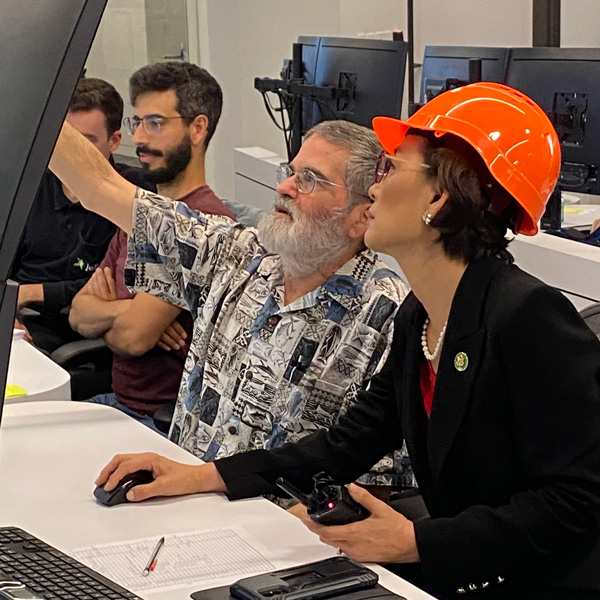
On Wednesday, U.S. Representative Young Kim (CA-40), U.S. Representative Don Beyer (VA-08), and U.S. Representative Mike Levin (CA-49) visited TAE Technologies, the world’s largest private fusion energy company. Rep. Beyer founded and co-chairs the bipartisan fusion energy caucus in 2021, which is touring energy facilities across California.
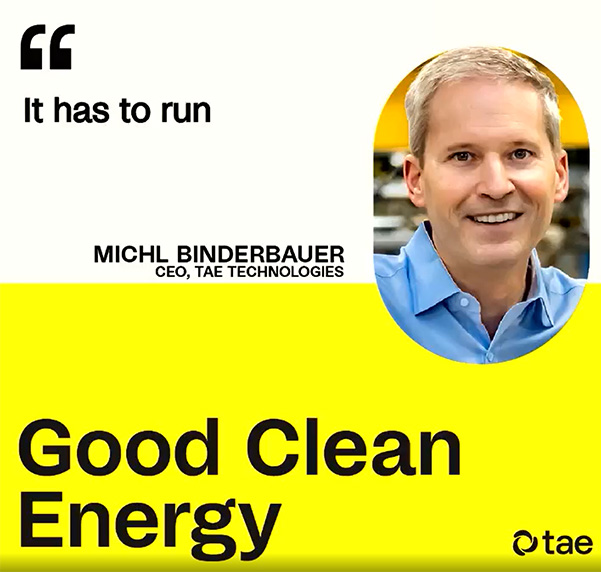
What makes TAE’s approach to commercial fusion so unique?
It starts with a specific fusion machine design called the Field-Reversed Configuration – a powerfully efficient method that TAE has advanced with our suite of original technologies.
But that’s not all. Listen to our “Good Clean Energy” interview with TAE CEO Michl Binderbauer to hear more about the advantages of our fusion technology and how we’ll use it to deliver commercial fusion power:
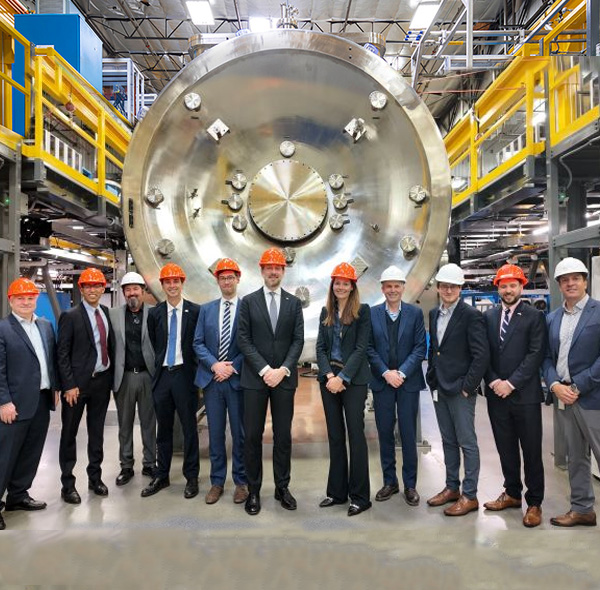
We were delighted to host UK Minister for Investment Poppy Gustafsson and HM Trade Commissioner Oliver Christian at our California headquarters for a tour of our first-of-its-kind fusion reactor prototype, Norm, and our fusion-enabled technologies.
Whether it’s with our hydrogen-boron fusion development; our transformative cancer therapy at TAE Life Sciences; or our more intelligent power management systems at TAE Power Solutions, we’re committed to advancing the frontiers of science for humanity’s benefit around the world. We’re thrilled to have collaborators in the UK and beyond as fellow innovators building a cleaner, healthier and brighter future for all.
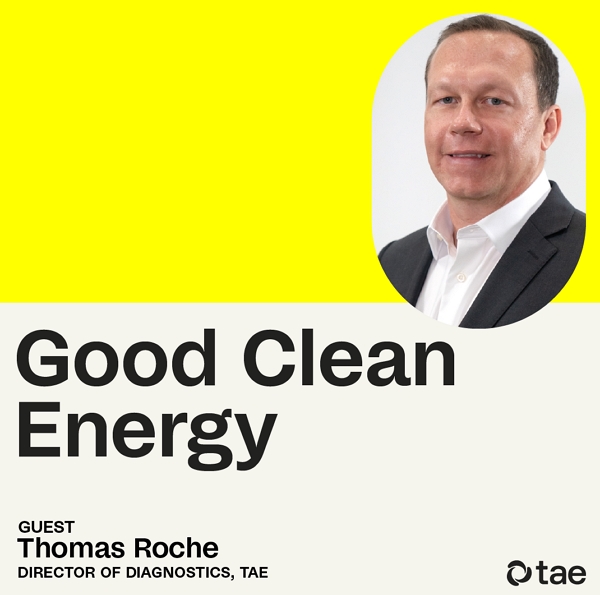
What does it feel like to achieve a first in fusion research history?
On this episode of “Good Clean Energy,” TAE Director of Diagnostics Thomas Roche takes us inside the experiment that led to TAE’s breakthrough fusion machine, Norm – the first reactor prototype that can produce an FRC plasma using only neutral beam injection.
“I remember having my jaw drop that day,” Roche says. “I never thought it would lead us to the state that we’re in now.”
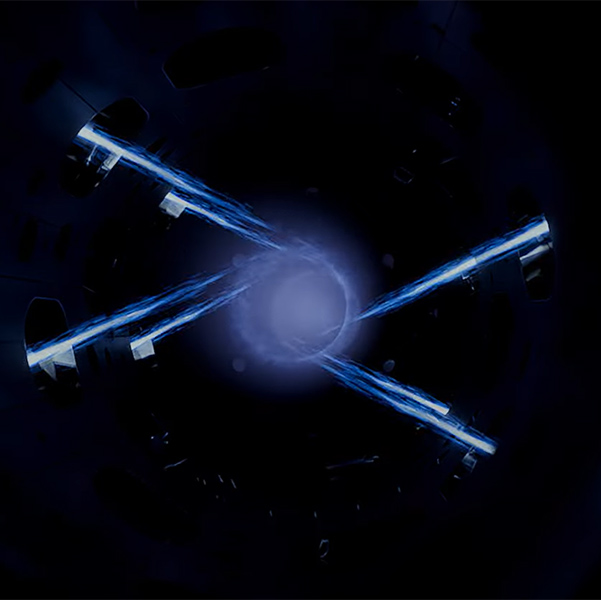
Reduce, reuse, recycle – but make it a fusion breakthrough 💫
We’re celebrating #EarthDay with the introduction of “Norm,” our first-of-its-kind fusion prototype that …
✂️ Reduces machine size by 50%
⬇️ Lowers operating costs
♻️ Recycles parts from our previous machine, Norman
🔁 Optimizes machine components that will be reused for our next-generation device, Copernicus
Norm’s smaller footprint and more efficient design isn’t just sustainable – it’s also accelerating our path to commercial fusion power. See how at TAE.com.
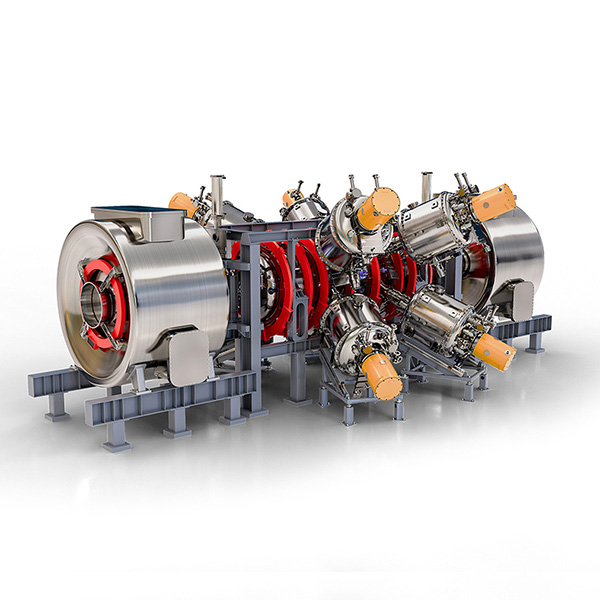
I am proud to share that TAE’s latest scientific milestone has been published in Nature Communications: the first-ever formation of an FRC plasma using only neutral beam injection.
This groundbreaking achievement marks a pivotal moment not just for TAE, but for fusion energy. By realizing this long-sought method of FRC formation, we’ve made our fusion technology even more efficient, practical and commercially viable.
With this accomplishment, TAE’s advanced beam-driven FRC platform becomes significantly more powerful and cost-effective for clean, abundant fusion energy.
I’m deeply grateful to our extraordinary scientists and engineers who led this research, and to every member of our TAE team whose shared purpose, passion and deep expertise allowed us to deliver this milestone.
At TAE, we don’t just aim to make progress, we aim to redefine what’s possible. We pursue bold ideas and back them with the focus and follow-through needed to bring them to life.
The results we’ve achieved with our streamlined machine, Norm, are a powerful testament to what’s possible when vision, innovation and teamwork align.
I’m honored to share this breakthrough with the world — and excited about its transformational impact on our net energy machine, Copernicus, and TAE’s future power plants.
LinkedIn: Nature Portfolio