Rotation Studies on the C-2 FRC Experiment
November 2011 | D. Gupta | APS-DPP | Poster
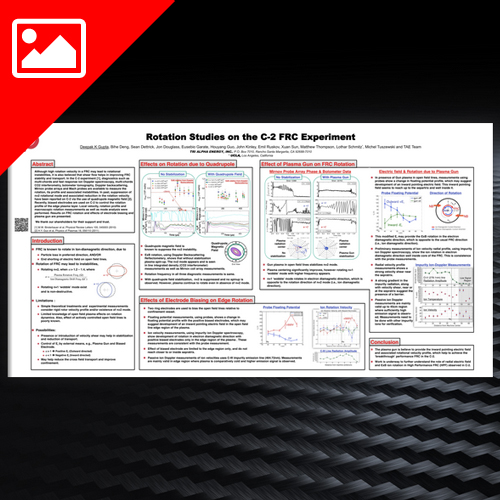
Although high rotation velocity in a FRC may lead to rotational instabilities, it is also believed that shear flow helps in improving FRC stability and transport.

November 2011 | D. Gupta | APS-DPP | Poster
Although high rotation velocity in a FRC may lead to rotational instabilities, it is also believed that shear flow helps in improving FRC stability and transport.
November 2011 | S. Korepanov | APS-DPP | Poster
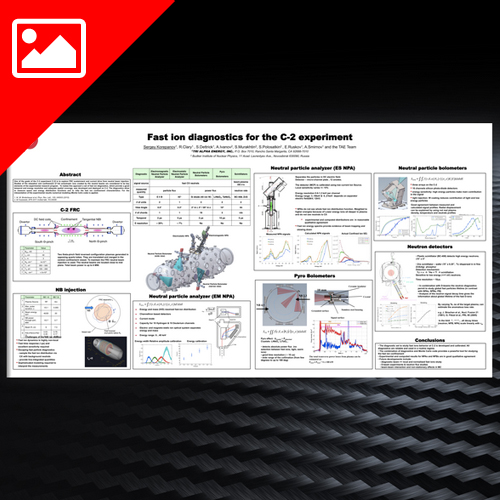
One of the goals of the C-2 experiment [1,2] is to explore FRC sustainment and current drive from neutral beam injection. Studies of the relaxation and confinement of hot anisotropic ions created by the neutral beams are considered to be key elements of the experimental research program.
November 2011 | T. Roche | APS-DPP | Poster
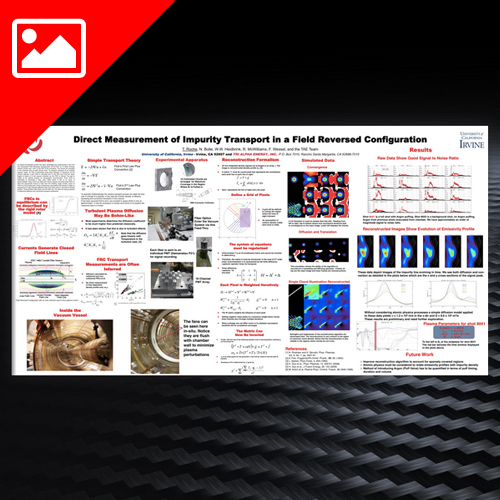
An optical tomography system has been developed and implemented in the Flux Coil Generated Field Reversed Configuration (FCG-FRC) at TAE Technologies.
November 2011 | E. Ruskov | APS-DPP | Poster
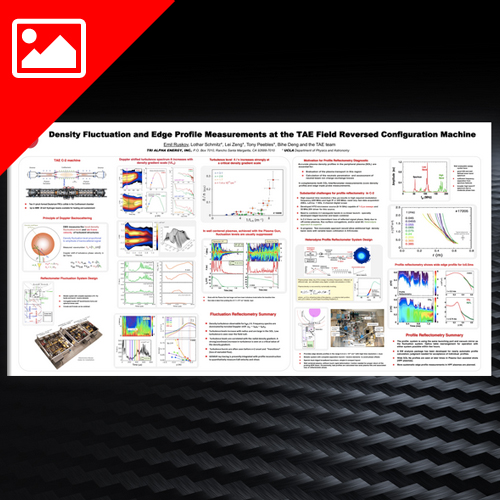
High required time resolution resolves in high required modulation frequency and high IF: need very fast data acquisition.
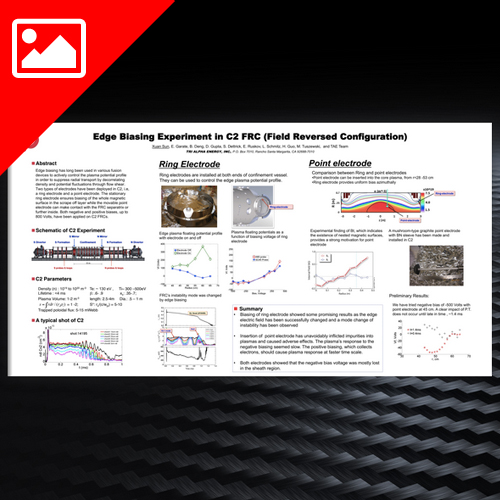
November 2011 | X. Sun | APS-DPP | Poster
Edge biasing has long been used in various fusion devices to actively control the plasma potential profile in order to suppress radial transport by decorrelating density and potential fluctuations through flow shear.
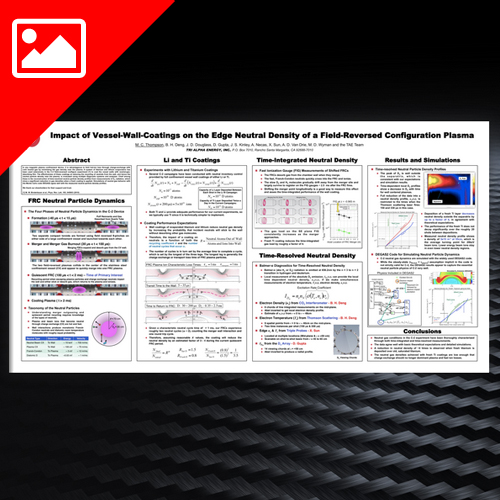
November 2011 | M. Thompson | APS-DPP | Poster
In any magnetic plasma confinement device, it is advantageous to limit hot-ion loss through charge-exchange with cold neutral gas by minimizing the gas density near the plasma.