Apr 2019 | Research Library, Posters, Confinement, Equilibrium, Fast Particles, Fusion Energy, Fusion Research, Fusion Science, Fusion Technology, Instabilities, Modeling, Overview, Plasma Research, Simulation, Stability, Theory, Transport, Turbulence
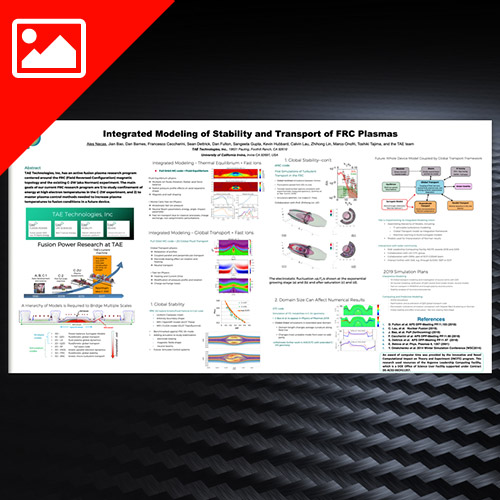
April 2019 | A.Necas | 2019 Sherwood Fusion Theory | Poster
TAE Technologies, Inc, has an active fusion plasma research program centered around the FRC (Field Reversed Configuration) magnetic topology and the existing C-2W (aka Norman) experiment.
Nov 2018 | Research Library, Posters, Equilibrium, Fusion Energy, Fusion Research, Fusion Science, Fusion Technology, Plasma Research, Simulation, Stability, Theory
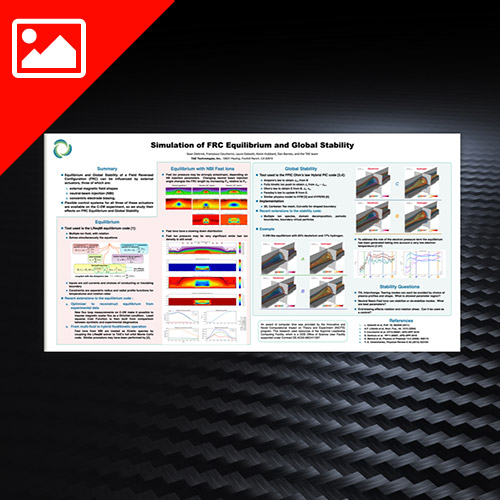
October 2018 | S. Dettrick | APS-DPP | Poster
Flexible control systems for all three of these actuators are available on the C-2W experiment, so we study their effects on FRC Equilibrium and Global Stability
Nov 2018 | Research Library, Posters, Equilibrium, Fusion Energy, Fusion Research, Fusion Science, Fusion Technology, Modeling, Plasma Profiles, Plasma Research, Theory
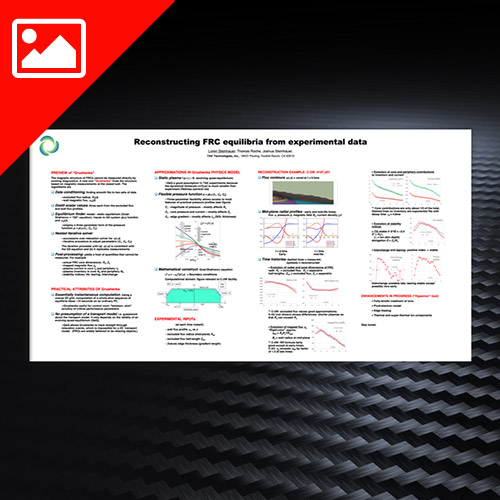
October 2018 | L. Steinhauer | APS-DPP | Poster
The magnetic structure of FRCs cannot be measured directly by existing diagnostics. A new tool “Grushenka” finds the structure based on magnetic measurements at the vessel wall.
Nov 2018 | Research Library, Posters, Fusion Energy, Fusion Research, Fusion Science, Fusion Technology, Modeling, Plasma Research, Simulation, Theory
October 2018 | A. Necas | APS-DPP | Poster
Spent nuclear fuel from current nuclear reactors generally managed by two distinct policies: once-through (U.S., Sw) and U/Pu recycling (Fr,J)
Oct 2018 | Research Library, Papers, Diagnostics, Fusion Energy, Fusion Research, Fusion Science, Fusion Technology, Instabilities, Modeling, Plasma Research, Theory, Top Level
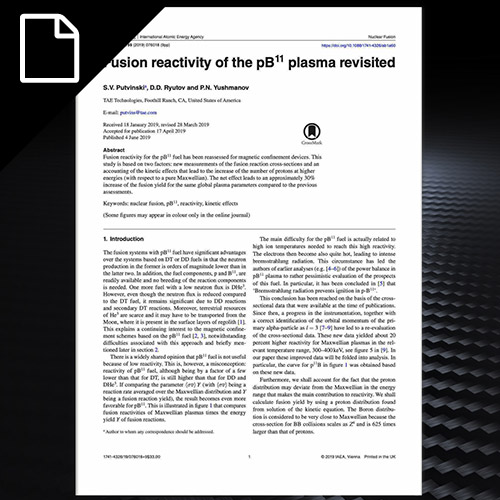
October 2018 | B. Deng | Nuclear Fusion | Paper
In modern F experiments at TAE Technologies, classical FRC instabilities are suppressed
by advanced neutral beam injection and edge biasing methods, leading to high plasma confinement and fast ion pressure built-up which is comparable to the bulk plasma pressure.
Oct 2018 | Research Library, Papers, Fusion Energy, Fusion Research, Fusion Science, Fusion Technology, Modeling, Plasma Research, Theory
July 2018 | J. Egedal | Physics of Plasmas | Paper
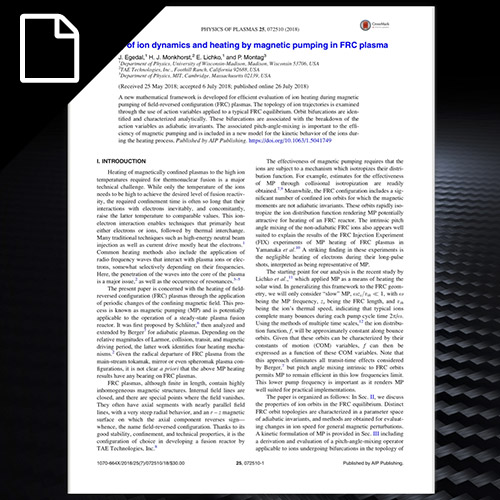
A new mathematical framework is developed for efficient evaluation of ion heating during magnetic pumping of field-reversed configuration (FRC) plasmas. The topology of ion trajectories is examined through the use of action variables applied to a typical FRC equilibrium.