
TAE Plots Irvine Expansion
TAE Technologies in Foothill Ranch is one step closer to making its ambitious dream of tapping into almost limitless supplies of energy come true, and is expanding its operations to Irvine to help move those plans forward.

TAE Technologies in Foothill Ranch is one step closer to making its ambitious dream of tapping into almost limitless supplies of energy come true, and is expanding its operations to Irvine to help move those plans forward.

TAE Technologies Inc., a nuclear fusion startup backed by Alphabet Inc.’s Google, Chevron Corp. and Japan’s Sumitomo Corp., hopes to see an “essential milestone” on its path to build a commercial fusion reactor by the middle of this decade. TAE’s efforts received a kickstart in July as the fusion startup secured $250 million in its latest funding round.
August 2022 | J. Titus | Review of Scientific Instruments | Paper
In TAE Technologies’ current experimental device, C-2W, record-breaking, advanced beam-driven FRC plasmas are produced and sustained in steady state utilizing

Google, the search giant owned by parent company Alphabet, has partnered with TAE since 2014, providing the fusion startup with artificial intelligence and computational power. But this marks Google’s first cash investment in TAE.
Our current domestic electrical grids are woefully inept to integrate necessary renewable energy sources. The answer to solving this problem lies within a new approach to energy use: one that focuses on optimizing the way customers and their technologies interact with the grid.
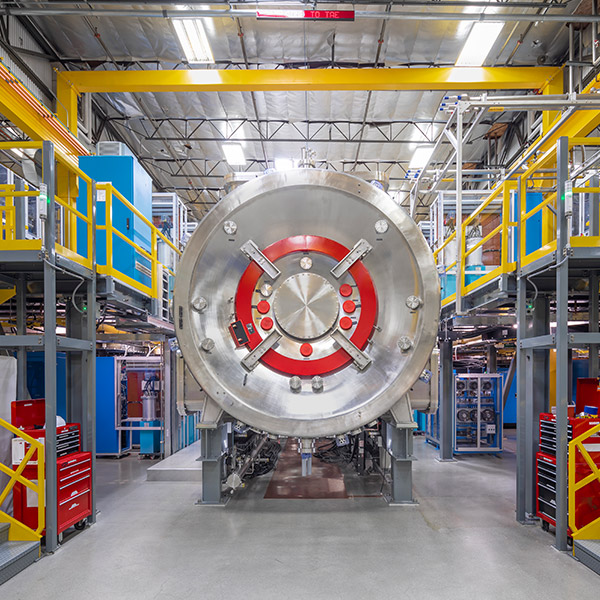
Following scientific milestones with current fusion reactor, Norman, TAE receives investments from long-term partner Google, as well as Chevron, Sumitomo Corporation of Americas, and others to fund the construction of the company’s sixth-generation research reactor that will demonstrate the viability of net energy from TAE’s approach

Reporting on challenges with tritium fuel for fusion, Science notes TAE Technologies has “decided to simply forgo tritium” to “use plain hydrogen and boron.” TAE’s hydrogen-boron fusion will “require higher temperatures than [deuterium-tritium], but the [company thinks] that’s a price worth paying to avoid tritium hassles” and produce the cleanest, safest fusion reaction.
June 2022 | A.Necas | TOFE | Poster
The C-2W experiment is a FRC with the addition of external actuators including NB injection, EB, and magnetic expander divertors to provide SOL pumping