Sep 2017 | Research Library, Papers, Equilibrium, Fusion Energy, Fusion Research, Fusion Science, Fusion Technology, Simulation, Theory, Transport
September 2017 | M. Onofri | Physics of Plasmas | Paper
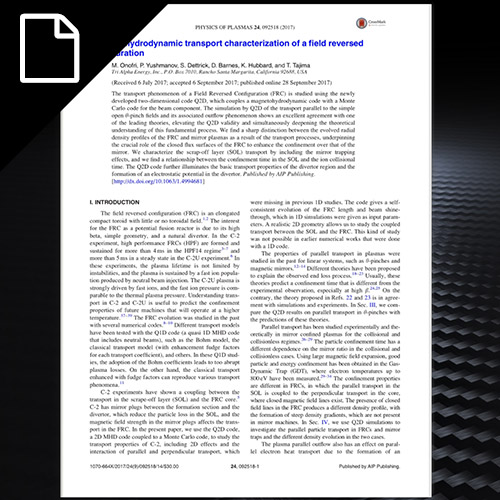
The transport phenomenon of a Field Reversed Configuration (FRC) is studied using the newly developed two-dimensional code Q2D, which couples a magnetohydrodynamic code with a Monte Carlo code for the beam component. The simulation by Q2D of the transport parallel to the simple open h-pinch fields and its associated outflow phenomenon shows an excellent agreement with one of the leading theories, elevating the Q2D validity and simultaneously deepening the theoretical understanding of this fundamental process.
May 2017 | Research Library, Posters, Diagnostics, Experiment, Fusion Energy, Fusion Research, Fusion Science, Fusion Technology, Plasma Research
May 2017 | D.P. Fulton | The Sherwood Fusion Theory Conference | Poster
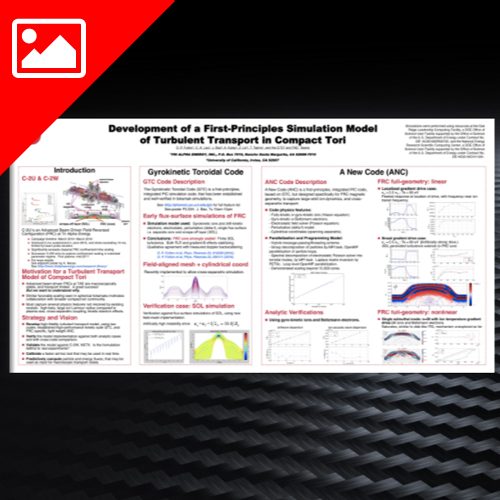
FRC core strongly stable! Finite SOL turbulence. Both FLR and gradient-B effects stabilizing. Qualitative agreement with measure doppler backscattering.
Dec 2016 | Research Library, Papers, Diagnostics, Edge Control, Experiment, Fusion Energy, Fusion Research, Fusion Science, Fusion Technology, Stability, Transport, Turbulence
December 2016 | L. Schmitz | Nature Communications | Paper
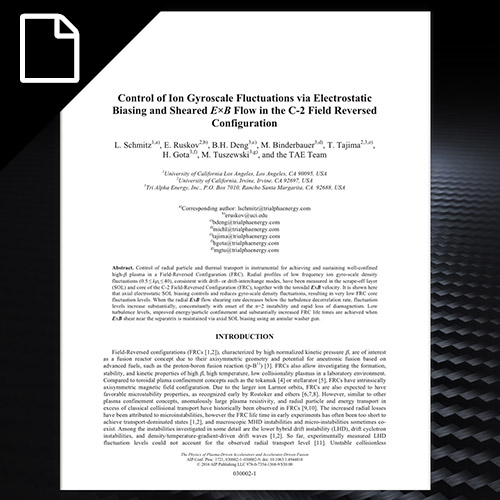
An economic magnetic fusion reactor favours a high ratio of plasma kinetic pressure to magnetic pressure in a well-confined, hot plasma with low thermal losses across the confining magnetic field.
Oct 2016 | Research Library, Posters, Experiment, Fusion Energy, Fusion Research, Fusion Science, Fusion Technology, Plasma Research, Transport
October 2016 | Erik Trask | APS-DPP | Poster
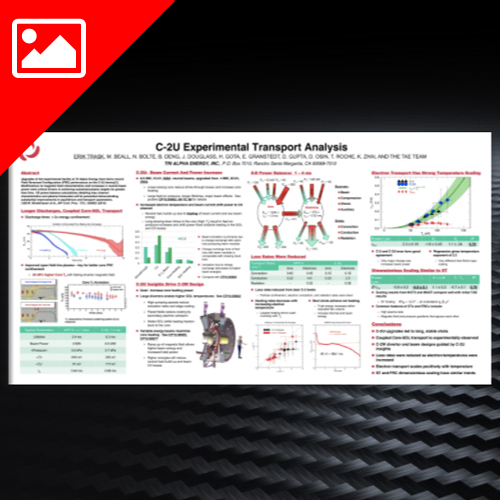
Upgrades of the experimental facility at TAE Technologies have led to record Field Reversed Configuration (FRC) performance on the C-2U device.
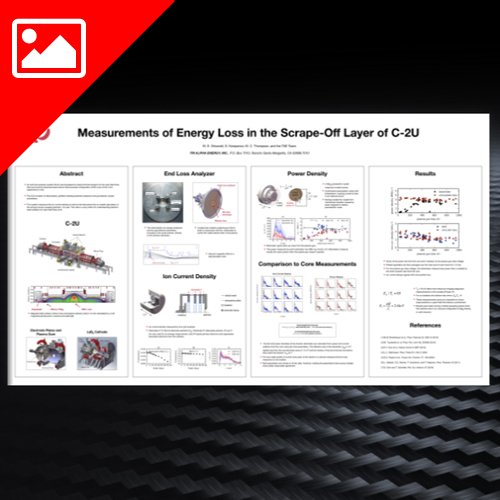
Oct 2016 | Research Library, Posters, Experiment, Fusion Energy, Fusion Research, Fusion Science, Fusion Technology, Plasma Research, Transport
October 2016 | M.E. Griswold | APS-DPP | Poster
An end loss analyzer system (ELA) was developed to study thermal transport on the open field lines that surround the advanced beam-driven field-reversed configuration (FRC) core of the C-2U experiment.