Nov 2020 | Research Library, Papers, Fast Particles, Fusion Energy, Fusion Research, Fusion Science, Fusion Technology, Instabilities, Modeling, Plasma Research, Simulation, Waves
November 2020 | B.S. Nicks | Nuclear Fusion | Paper
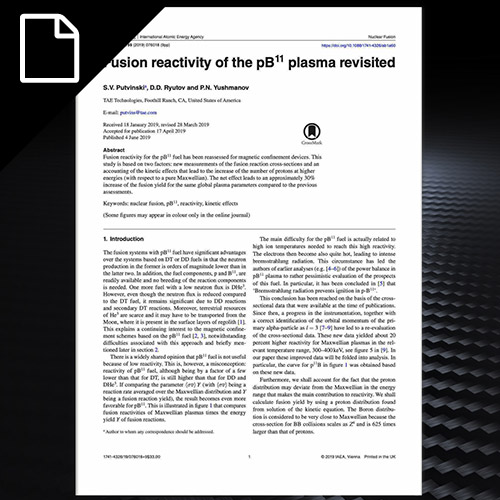
In the scrape-off-layer (SOL) of a field-reversed configuration, neutral beam injection can drive
modes in the vicinity of the ion-cyclotron frequency
Sep 2020 | Research Library, Papers, Experiment, Fusion Energy, Fusion Research, Fusion Science, Fusion Technology, Heating, Plasma Research, Waves
September 2020 | X. Yang | AIP Conference Proceedings | Paper
Simulation survey performed at TAE Technologies, has demonstrated that HHFW heating is a promising scenario to heat core electrons of FRC plasma.
Oct 2017 | Research Library, Papers, Fusion Energy, Fusion Research, Fusion Science, Fusion Technology, Heating, Simulation, Waves
October 2017 | X. Yang | EPJ Web Conference | Paper
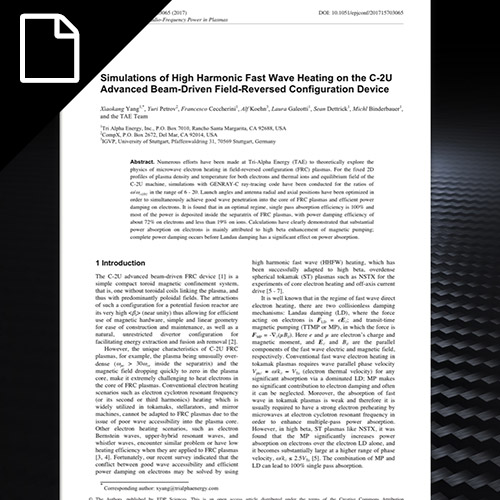
Numerous efforts have been made at Tri-Alpha Energy (TAE) to theoretically explore the physics of microwave electron heating in field-reversed configuration (FRC) plasmas. For the fixed 2D profiles of plasma density and temperature for both electrons and thermal ions and equilibrium field of the C-2U machine, simulations with GENRAY-C ray-tracing code have been conducted for the ratios of / ci[D] in the range of 6 – 20.
Oct 2017 | Research Library, Posters, Fusion Energy, Fusion Research, Fusion Science, Fusion Technology, Heating, Plasma Research, Theory, Waves
October 2017 | Francesco Ceccherini | APS-DPP | Poster
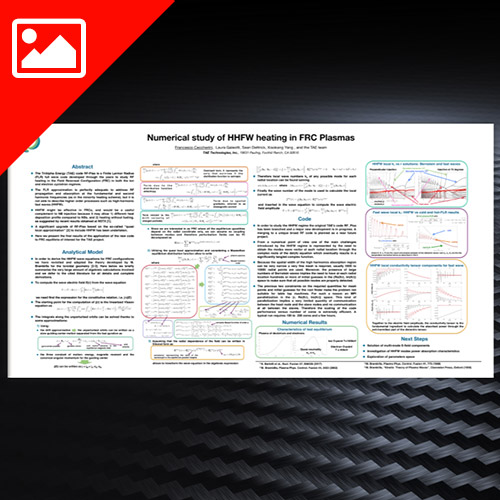
The Tri Alpha Energy (TAE) code RF-Pisa is a Finite Larmor Radius (FLR) full wave code developed through the years to study RF heating in the Field Reversed Configuration (FRC) in both the ion and electron cyclotron regimes.
Aug 2017 | Research Library, Papers, Equilibrium, Fusion Energy, Fusion Research, Fusion Science, Fusion Technology, Simulation, Stability, Theory, Turbulence, Waves
August 2017 | C. K. Lau | Physics of Plasmas | Paper
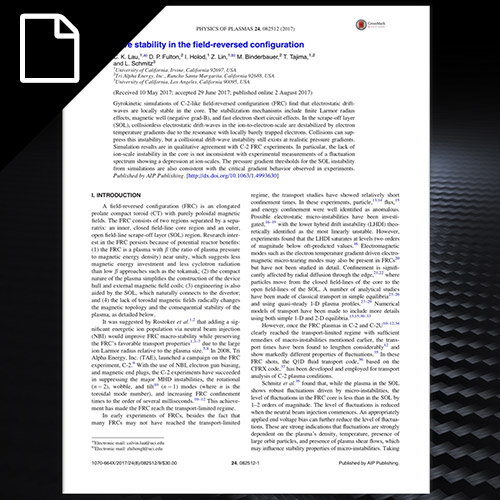
Gyrokinetic simulations of C-2-like field-reversed configuration (FRC) find that electrostatic drift- waves are locally stable in the core. The stabilization mechanisms include finite Larmor radius effects, magnetic well (negative grad-B), and fast electron short circuit effects.